
Understanding your electricity bill is an important part of managing your organization’s energy use and costs. This page is designed to help large-use customers navigate their monthly bill, understand how charges are calculated and identify the information that matters most to their business.
Choose your bill type below to explore each section of your bill and learn more about your electricity charges and consumption.
Class B customers with electricity demand greater than 50 kW are typically commercial, institutional or industrial customers whose electricity charges are based on both the amount of electricity they use and their peak demand.
Pinch anywhere on the bill sample below to zoom
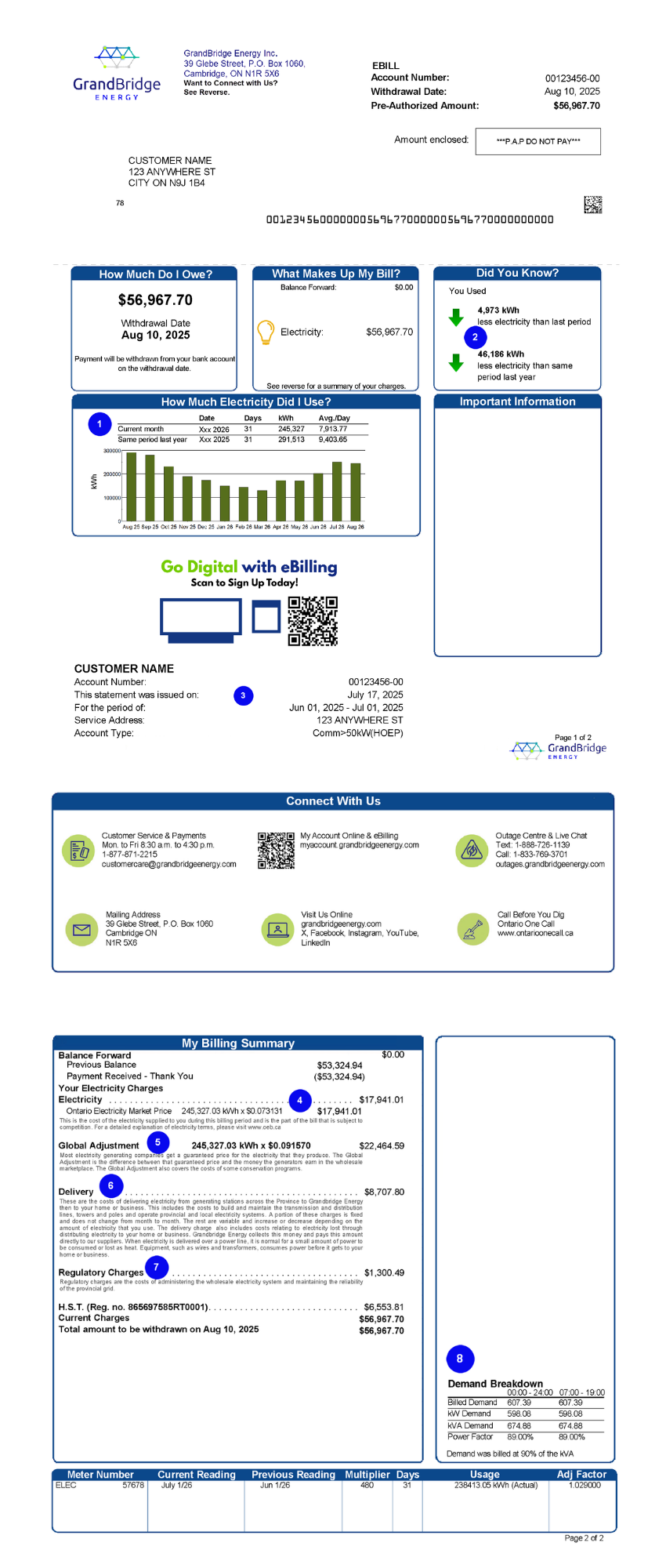
Class B customers with electricity demand greater than 50 kW are typically commercial, institutional or industrial customers whose electricity charges are based on both the amount of electricity they use and their peak demand.
This section shows your total metered loss-adjusted electricity consumption, the number of days in the billing period and your average daily usage in kilowatt-hours (kWh).
Your consumption is also compared with the same billing period from the previous year, providing a consistent year-over-year comparison of your electricity usage.
This portion of your bill shows whether your electricity usage increased or decreased compared with your previous bill. It also compares an increase or decrease in usage with the same billing period from the previous year, providing a more accurate year-over-year comparison.
This section provides key details about your account and bill, including the business name, bill issue date, billing period, service address and account type.
Large Class B customers pay the Ontario Electricity Market Price (OEMP) for the electricity they use. This is the wholesale price of electricity in Ontario, which changes hourly based on province-wide electricity demand and available supply.
The OEMP replaced the previous Hourly Ontario Energy Price (HOEP) on May 1, 2025, as part of the Independent Electricity System Operator’s (IESO) Market Renewal Program.
For more information on the OEMP, visit: https://www.ieso.ca/Learn/Electricity-Pricing-Explained/Medium-and-Large-Businesses.
Businesses with a monthly peak demand of 50 kilowatts (kW) or more pay the Ontario Electricity Market Price (OEMP) plus Global Adjustment (GA).
Global Adjustment covers the difference between the market price of electricity and the contracted or regulated amounts paid to certain electricity generators. It also helps fund electricity system programs, including conservation initiatives.
All electricity customers contribute to Global Adjustment. For customers on the Regulated Price Plan (RPP), GA is included in the electricity price. For non-RPP customers, GA is charged separately on the bill using either the Class A or Class B methodology.
Class B customers are charged based on their loss-adjusted electricity consumption (kWh) and the IESO’s first estimated GA rate for the month. The IESO publishes this estimate on the last business day of the previous month.
The Delivery charge covers the cost of delivering electricity from generating stations across the province to GrandBridge Energy and then to your business. It includes the cost of building, maintaining and operating the provincial transmission system and GrandBridge Energy’s local distribution system.
For General Service customers greater than 50 kW, Delivery charges include a monthly distribution service charge, a local distribution charge based on demand (kW), applicable rate riders, low-voltage service charges and retail transmission charges. GrandBridge Energy’s distribution rates are approved by the Ontario Energy Board (OEB).
Delivery charges, and some regulatory charges, may vary between GrandBridge Energy service territories. Separate rate tariffs will remain in place until rates are harmonized, expected for 2032 distribution rates.
- To learn more about Delivery/Regulatory charges for Brantford: View the Rate Card
- To learn more about Delivery/Regulatory charges for Brant County, Cambridge, North Dumfries: View Rate Card
Regulatory Charges include the Wholesale Market Service Charge, Capacity Based Recovery charge, and Rural or Remote Electricity Rate Protection charge. These province-wide charges support the operation of Ontario’s electricity market, demand-response programs and reliable electricity service across the province. A Standard Supply Administration Fee may also apply.
Your demand breakdown consisted of the following components:
- Billed Demand: The demand amount used to calculate applicable demand-based charges on your bill. For your rate class, billed demand is the greater of your measured kW demand or 90% of your measured kVA demand. Basing billed demand on this amount ensures demand charges reflect the total electrical capacity needed to serve the customer’s equipment.
- kW Demand: The highest rate at which your business used electricity during the billing period, measured in kilowatts (kW). It reflects the peak amount of real power your business required at one time.
- kVA Demand: Measures your business’s total demand on the electricity system, including both the power used to perform work and the additional power required to support equipment such as motors, transformers and other inductive loads.
- Power Factor: Measures how efficiently your business converts the electricity supplied to it into useful power. It is generally calculated by comparing kW demand with kVA demand. A lower power factor means more electrical capacity is required to provide the same amount of useful power and may result in higher demand-related charges.
Global Adjustment
Global Adjustment (GA) is a charge that helps cover the difference between the market price of electricity and the cost of generating and delivering a reliable supply of electricity in Ontario. It also supports conservation programs and other electricity system costs. How Global Adjustment appears on your bill depends on your customer classification and electricity pricing structure. For more information about Global Adjustment, including how it is calculated, visit the Independent Electricity System Operator (IESO) website.
Learn More About Global AdjustmentExplore Our Rates
Delivery charges, and some regulatory charges, may vary between GrandBridge Energy service territories. Separate rate tariffs will remain in place until rates are harmonized, expected for 2032 distribution rates.
Register for Paperless Billing
Sign up for My Account to receive paperless billing and reduce your environmental footprint. My Account provides convenient online access to your bills and transaction history whenever you need them. For detailed electricity consumption information, large-use customers must also register for the Large User Portal.
Class A customers are large electricity users whose demand meets the eligibility requirements established under Ontario’s Industrial Conservation Initiative (ICI). Rather than paying Global Adjustment (GA) based solely on monthly electricity consumption, Class A customers’ GA costs are determined by their contribution to Ontario’s highest-demand periods, known as the five coincident peaks. This gives eligible customers an opportunity to manage their electricity costs by reducing demand during peak periods.
Pinch anywhere on the bill sample below to zoom
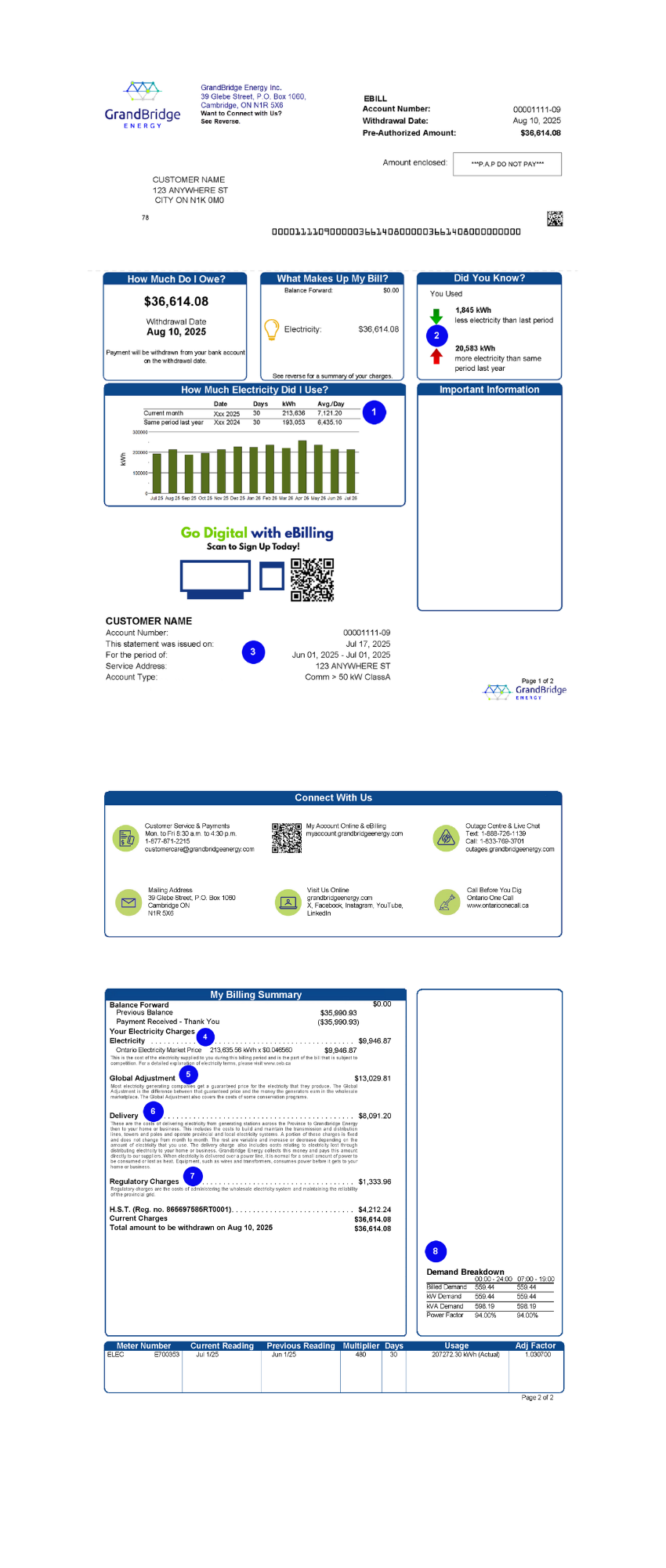
Class A customers are large electricity users whose demand meets the eligibility requirements established under Ontario’s Industrial Conservation Initiative (ICI). Rather than paying Global Adjustment (GA) based solely on monthly electricity consumption, Class A customers’ GA costs are determined by their contribution to Ontario’s highest-demand periods, known as the five coincident peaks. This gives eligible customers an opportunity to manage their electricity costs by reducing demand during peak periods.
This section shows your total metered loss-adjusted electricity consumption, the number of days in the billing period and your average daily usage in kilowatt-hours (kWh).
Your consumption is also compared with the same billing period from the previous year, providing a consistent year-over-year comparison of your electricity usage.
This portion of your bill shows whether your electricity usage increased or decreased compared with your previous bill. It also compares an increase or decrease in usage with the same billing period from the previous year, providing a more accurate year-over-year comparison.
This section provides key details about your account and bill, including the business name, bill issue date, billing period, service address and account type.
Class A customers pay the Ontario Electricity Market Price (OEMP) for the electricity they use. This is the wholesale price of electricity in Ontario, which changes hourly based on province-wide electricity demand and available supply.
The OEMP replaced the previous Hourly Ontario Energy Price (HOEP) on May 1, 2025, as part of the Independent Electricity System Operator’s (IESO) Market Renewal Program.
For more information on the OEMP, visit: https://www.ieso.ca/Learn/Electricity-Pricing-Explained/Medium-and-Large-Businesses.
Businesses with a monthly peak demand of 50 kilowatts (kW) or more pay the Ontario Electricity Market Price (OEMP) plus Global Adjustment (GA).
Global Adjustment covers the difference between the market price of electricity and the contracted or regulated amounts paid to certain electricity generators. It also helps fund electricity system programs, including conservation initiatives.
The GA is charged separately on the bill using either the Class A or Class B methodology.
Class A customers participate in the Industrial Conservation Initiative. Their monthly Global Adjustment charge is based on their Peak Demand Factor (PDF), rather than a rate per kilowatt-hour. The PDF is determined by the customer’s share of electricity withdrawn during Ontario’s five highest system-demand hours in the preceding May-to-April base period. That PDF is then used from July 1 to June 30 of the following adjustment period. Each month, the customer’s PDF is multiplied by the province-wide Global Adjustment costs for that month.
Peak Demand Factor (PDF): The percentage used to determine a Class A customer’s share of Global Adjustment and Capacity Based Recovery costs. It is based on the customer’s electricity consumption during Ontario’s five highest demand hours in the applicable base period, compared with total Ontario consumption during those same hours. A lower contribution during these coincident peak hours can reduce the customer’s future Class A allocation.
For more information on calculating class A Global Adjustment and Peak Demand Factor visit: https://www.ieso.ca/sector-participants/settlements/global-adjustment-and-peak-demand-factor
The Delivery charge covers the cost of delivering electricity from generating stations across the province to GrandBridge Energy and then to your business. It includes the cost of building, maintaining and operating the provincial transmission system and GrandBridge Energy’s local distribution system.
For General Service customers greater than 50 kW, Delivery charges include a monthly distribution service charge, a local distribution charge based on demand (kW), applicable rate riders, low-voltage service charges and retail transmission charges. GrandBridge Energy’s distribution rates are approved by the Ontario Energy Board (OEB).
Delivery charges, and some regulatory charges, may vary between GrandBridge Energy service territories. Separate rate tariffs will remain in place until rates are harmonized, expected for 2032 distribution rates.
To learn more about Delivery/Regulatory charges for Brantford: https://grandbridgeenergy.com/wp-content/uploads/2025/12/2026-Rate-Card-GBEBPI.pdf
To learn more about Delivery/Regulatory charges for Brant County, Cambridge, North Dumfries: Rate Cards Presentation – 2026
Regulatory Charges include the Wholesale Market Service Charge, Capacity Based Recovery (CBR) charge, and Rural or Remote Electricity Rate Protection charge. For a Class A customer, the CBR amount is calculated using the customer’s Peak Demand Factor (PDF). The monthly Ontario-wide CBR amount is multiplied by the customer’s PDF to determine their charge. These province-wide charges support Ontario’s electricity market, capacity and demand-response programs, and electricity affordability in eligible rural and remote areas. A Standard Supply Administration Fee may also apply.
Your demand breakdown consisted of the following components:
- Billed Demand: The demand amount used to calculate applicable demand-based charges on your bill. For your rate class, billed demand is the greater of your measured kW demand or 90% of your measured kVA demand. Basing billed demand on this amount ensures demand charges reflect the total electrical capacity needed to serve the customer’s equipment.
- kW Demand: The highest rate at which your business used electricity during the billing period, measured in kilowatts (kW). It reflects the peak amount of real power your business required at one time.
- kVA Demand: Measures your business’s total demand on the electricity system, including both the power used to perform work and the additional power required to support equipment such as motors, transformers and other inductive loads.
- Power Factor: Measures how efficiently your business converts the electricity supplied to it into useful power. It is generally calculated by comparing kW demand with kVA demand. A lower power factor means more electrical capacity is required to provide the same amount of useful power and may result in higher demand-related charges.
Industrial Conservation Initiative (ICI)
The Industrial Conservation Initiative (ICI) helps large electricity users manage Global Adjustment (GA) costs by reducing or shifting electricity use during periods of peak provincial demand. Customers may qualify if their average monthly peak demand is over 500 kW and under 5 MW, with specific eligibility requirements for customers between 500 kW and 1 MW. Customers with average demand above 5 MW automatically qualify.
Review ICI EligibilityExplore Our Rates
Delivery charges, and some regulatory charges, may vary between GrandBridge Energy service territories. Separate rate tariffs will remain in place until rates are harmonized, expected for 2032 distribution rates.
Sign Up for Paperless Billing
Sign up for My Account to receive paperless billing and reduce your environmental footprint. My Account provides convenient online access to your bills and transaction history whenever you need them. For detailed electricity consumption information, large-use customers must also register for the Large User Portal.